
10 reasons why poor and middle class should not vote for the DA

With the upcoming elections, individuals, especially those living in poverty, are facing the challenging task of deciding who to vote for. The problem of corruption within our government has only added to this dilemma. However, it is important to recognise that corruption is not limited to a specific political party or South Africa alone. Certain parties may just be better at hiding it. Tactics like deflection, fear-mongering, bribery, money laundering, and nepotism are commonly employed to mask corrupt practices. Consequently, it can be argued that corruption exists in nearly all political parties about 99% of the time. This raises the question: when faced with corruption across the board, how does one decide who to vote for?
The answer is simple: align your vote with your own goals and aspirations. For education purposes, Our focus will be on the 80% of the population living in extreme poverty, as contributing to a better South Africa necessitates advocating for the interests of the majority.
While it is true that there is a political party for everyone, exercising your democratic right involves voting for those who genuinely prioritise your well-being. It is inappropriate for any party to demand votes from a population they clearly disregard. One notable instance is found in the Western Cape, where it seems the DA primarily serves the interests of the affluent. In this article, I will elucidate why this party is not conducive to the majority living in extreme poverty.
- Economic Policies: The Democratic Alliance (DA) strongly supports free-market policies that prioritize the interests of businesses over social welfare. However, this approach may have adverse effects on the poor and middle class, leading to income inequality and limited access to essential services. One example that the DA has been vocal about is:
- Minimum wage: The DA proposes the elimination of the minimum wage, allowing companies to determine the wages they pay to employees. Currently, the minimum wage is set at R4400 as of 1 March 2024, and non-compliance can result in fines. Under the DA’s policy, there would be no minimum wage, leaving employees vulnerable to exploitation and reminiscent of times of slavery. While some small business owners may perceive this as beneficial, it is important to note that the current government has already made provisions where small business owners who genuinely cannot afford the minimum wage can be exempted from paying it if they can prove it. Which proves that this policy seems to primarily benefit the ultra-rich individuals who fund the DA, such as Ruperts and Oppenheimers, as well as corporate companies whose CEOs earn exorbitant salaries. Notable examples include Datatec’s CEO earning 254 million rand per annum, Naspers CEO earning 107 million rand per annum, MTN’s CEO earning 77 million rand, and the list goes on. The DA’s proposal raises concerns about perpetuating the gap between the rich and the poor, which is deeply concerning.
- Here are a few links that provide information about the Democratic Alliance’s (DA) stance on the minimum wage:
- SABC News: DA’s protest against minimum wage
- TikTok video: DA’s stance on minimum wage
- These links provide insights into the DA’s position on the minimum wage issue.
- Education: The education policies of the DA consistently prioritize private schools or previously model C schools over public schools in poorer communities. This results in limited access to quality education for those who cannot afford private school fees, which further perpetuates inequality. Under the leadership of the DA, poorer communities have experienced school closures and budget cuts for years. Despite already overcrowded classrooms and teachers having heavy workloads, thousands of teachers recently lost their jobs as part of an effort to cut over 800 million from the budget. Interestingly, the same amount of money was allocated to building contractors for school construction.
- Healthcare: The DA’s focus on private healthcare may lead to a lack of investment in public healthcare systems. This could make healthcare services less accessible and affordable for the poor and middle class. Despite the NHI bill being signed into law on 15 May 2024, the DA is threatening legal action as they are in opposition to the bill. However, what exactly does the NHI Bill entail?
- The NHI bill aims to establish a National Health Insurance system that provides universal healthcare coverage for all citizens. Currently, only 14.2% of the population, approximately 8.5 million people out of 60 million, have private health care cover or medical aid. The distribution of medical aid coverage reveals a significant disparity, with 78% of the white population having medical aid, compared to only 9% of the black population and 19% of the coloured population. This highlights the persisting inequality gap in South Africa.
- The DA opposes this Bill for several reasons, which are evident in the statistics. While some individuals have the privilege of accessing private healthcare, others struggle to receive adequate care in overburdened public hospitals. Additionally, medical schemes can no longer prioritize profit over the well-being of individuals. Consider the scenario where a family of four pays 1 million rand for medical aid over a decade, but only receives a coverage of around a hundred thousand rand to date. This situation highlights the exploitation within the free market system.
- Here is some information about the NHI Bill:
- Parliament.gov.za – NHI Bill
- Health.fs.gov.za – NHI Questions and Answers
- SABC News – NHI Article
- 188-2/
- Housing: The DA’s approach to addressing housing needs has been criticized for prioritizing market-driven solutions over the needs of the poor and middle class. Instead of using city land to build houses for the poor, it has been auctioned off to developers. Furthermore, funds have been allocated to upgrade affluent areas, such as building bicycle lanes, rather than investing in housing for those in need. One example of this is the City of Cape Town’s announcement in 2017 to develop housing on 11 parcels of public land in Salt River, Woodstock, and the inner city. However, as of 2024, these 11 pieces of land remain vacant with no significant development taking place. This poor performance can be traced back to as early as 2010, despite identifying land for RDP homes, they decided to spend 66 million on a flood plain instead. For more information and references, you can refer to these articles: Article 1 Article 2
- Public Transport: The ongoing conflicts between the DA and mini bus drivers in the realm of public transport have been a cause for concern. It seems that mini bus drivers are being disproportionately targeted by authorities, resulting in their vehicles being impounded due to legal and road safety violations. This not only creates further challenges for commuters who rely on these modes of transport to get to work but also raises questions about the DA’s true intentions regarding safety. If the DA genuinely prioritised safety, they would explore the various solutions that have been proposed and introduced by the ANC while they were in power. but the moment DA took office in 2009, they diverted the resources meant for the less fortunate towards more affluent areas. It is important to note that the original purpose of the mycity bus was to address the transportation issues faced by the working class along the N2 routes, specifically benefiting black and coloured commuters. However, this proposal was redirected towards the milnerton areas. For a more in-depth understanding of this matter, I recommend listening to Ebrahim Rasool as he discusses this topic amidst the last taxi strikes. You can find his address here: Link to Ebrahim Rasool’s video
- Inequality: The DA’s focus on individual responsibility and meritocracy may overlook systemic factors that contribute to inequality. This approach may not address the root causes of poverty and may perpetuate existing disparities.
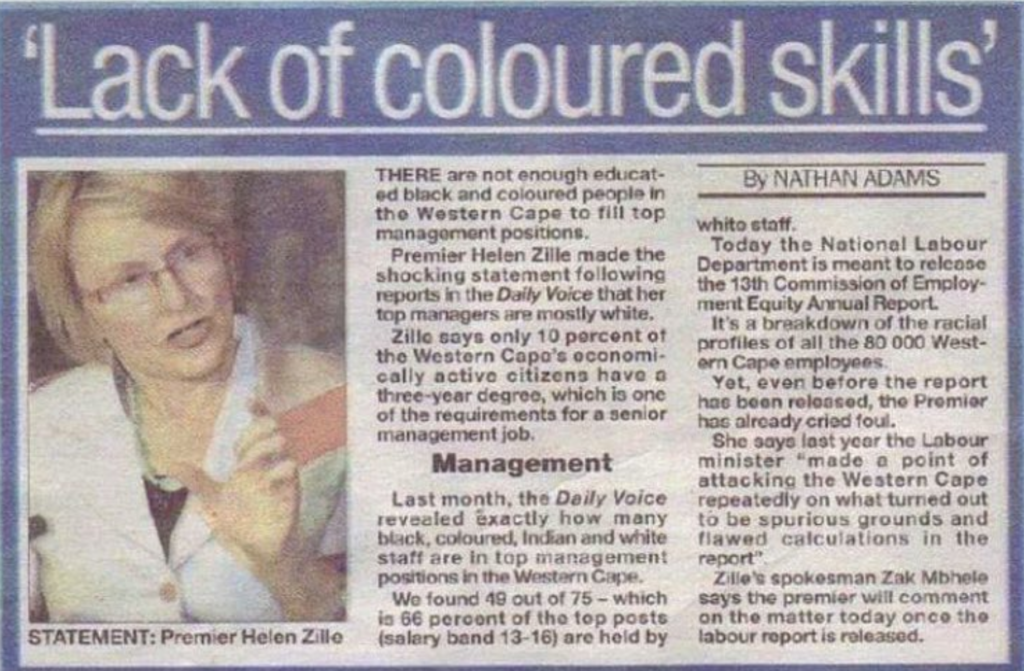
The article mentioned above has not aged well. The DA claims that people of colour and black individuals lack the education necessary to hold top management positions in government. They argue that a minimum of a 3-year degree is required for such positions. However, during my time, I observed that graduates from UWC and CPUT, where a majority of them were coloured, were filling the podium at an alarming rate. It is interesting to note that coloured individuals started complaining about being marginalised from education and city of cape town positions since the DA came into power. Before that, our people did not face difficulties in finding university placements, bursaries, or work. However, since the DA governed Cape Town, opportunities for the coloured population have declined. It is also concerning that only coloured and black candidates are expected to have a minimum degree, while white candidates are automatically exempted. It is no secret what qualifications the highest DA officials hold, and if qualifications are being discussed, one should be prepared for backlash and mockery, as one leader is still defending himself to this day. Based on my experience, I often find that white individuals confidently apply with Udemy certificates or none, for positions that usually requires 3 year qualification, while coloured and black individuals typically submit applications accompanied by a 3-year degree or diploma. This raises the question of whether there are more suitably qualified black and coloured individuals? or if white individuals know that they can still secure a high level position despite lacking formal qualifications.
7. Access to Justice: The DA’s approach to the justice system may favour the rights of the accused over the rights of victims. This could limit access to justice for marginalised communities and the poor.
An example of how the Democratic Alliance’s (DA) approach to the justice system may favor the rights of the accused over the rights of victims is through their emphasis on protecting individual liberties and due process. While these principles are important for ensuring fairness and preventing wrongful convictions, there is a concern that it could result in a system that prioritizes the rights of the accused over the rights and interests of victims.
Although high crime rates on the Cape Flats are mostly influenced by a combination of socio-economic factors, historical legacies, and the presence of gangs, its important to note that the DA’s governance in Cape Town may have also had some impact.
8. Representation: The DA’s historical ties to privileged elites may result in a lack of understanding and representation for the poor and middle class. This can lead to policies that fail to address their needs effectively. The DA is the wealthiest political party in South Africa, with over 127 million in declared funds, mostly sponsored by wealthy individuals including Oppenheimers. In comparison, the ANC, the party with the second most donation, has only 47 million in declared funds. It is clear that who has significant influence over Cape Town, the same people who benefited from the apartheid system. This raises concerns about having a political party on their payroll, as it lead to policies that favour the wealthy and leave those in extreme poverty at a disadvantage. It is important not to be deceived by claims of being the “best run province.” One only needs to drive through Cape Flats and townships to see that the city is only well-run for the 1% of the population.
9. Gentrification : The issue of gentrification in Cape Town, particularly under the governance of the DA, is a topic of concern and debate. Gentrification refers to the process of urban renewal, often involving the influx of wealthier residents and the transformation of lower-income neighborhoods.
The DA’s policies and initiatives in Cape Town have contributed to the displacement of lower-income communities and the loss of affordable housing. The focus on attracting investment and promoting tourism has prioritised the interests of affluent individuals and corporations over the needs and rights of the local population.
One of the key criticisms is the eviction of residents from informal settlements and the demolition of their homes in the name of urban development. This has led to the forced relocation of marginalized communities, disrupting their social networks and access to basic services. The rapid increase in property prices and rental rates in certain neighborhoods has further exacerbated the issue, making it difficult for long-term residents to afford to live in their own communities.
Additionally, there are concerns about the impact of gentrification on cultural heritage and diversity. As neighbourhoods undergo significant changes to cater to wealthier residents and tourists, there is often a loss of authenticity and the erasure of local traditions and businesses.
While the DA may argue that gentrification brings economic growth and development to the city, but the benefits are not evenly distributed and often exclude those who are most vulnerable. We need more inclusive and equitable approaches to urban development that prioritise affordable housing, community engagement, and the preservation of cultural identity. herewith a few links on topic regarding the gentrification in Cape Town under DA leadership.
For further information on the topic of gentrification in Cape Town under the leadership of the DA, you may find the following links helpful:
- Bo-Kaap residents are rocked by the potential gentrification underway
- Video: Gentrification in Cape Town – A Closer Look
10. Genocide supporter: The DA’s historical support for Israel, despite the ongoing conflict and loss of lives in Palestine, raises concerns about their stance on human rights. With the reported number of murders exceeding 40,000, including a significant proportion of women and children, the situation in Palestine is reminiscent of the apartheid years. This raises questions about whether, under the leadership of the DA, we are essentially living under a re-branded form of apartheid.
In addition to the issue of Palestine, there are other policies under DA leadership that have drawn criticism. These include the eviction of squatters, the imposition of fines on homeless people, and the restriction of trading activities for traders in Salt River, High municipal tariffs, among others. This Clearly shows that the DA does not care about the working class.
For more information on the latest news regarding the ongoing conflict in Palestine, you may find the following links useful:
Related News

Former President Jacob Zuma’s New Political Party MK Makes Waves in 2024 Elections, Pushing ANC below 50% and EFF to fourt
In a stunning turn of events, former President Jacob Zuma, known for his unconventional riseRead More

White Privilege: An Unresolved Issue That Persists in Society Today.
White privilege is a deeply ingrained societal advantage that benefits individuals solely based on theirRead More